Budgeting Window Treatments for Your New Westfield Home
Nobody budgets for window coverings until the house is nearly done, and by then the money is mostly spent elsewhere. A new home usually has more windows than the last one, and they're often taller. Here's what a builder allowance actually buys in a new Westfield home, and how to phase the rest of the work once you know where the real cost lives.
What a builder allowance actually buys
A builder allowance is almost always spent on stock coverings, cut down on site to fit standard openings in fixed increments. Nothing wrong with that as a starting point, it's just not tailored: the cut edge isn't a factory edge, and you typically get one white and one light filtering option for the entire house, not a color or opacity choice per room.
Stock coverings run roughly $60 to $600 a window nationally. Custom, measured in the home and installed, runs roughly $250 to $2,600. That gap is the whole story behind most Westfield allowance surprises: the package handles a hallway just fine and does nothing for a bedroom you actually want dark.
Phase the house instead of doing it all at once
A new house doesn't need every window covered on day one. What it needs immediately is privacy at eye level, bedrooms, bathrooms, a home office with a screen in the window, anything the street or a neighbor looks straight into. Inexpensive temporary paper shades handle the rest for a few months and come down without leaving marks.
After that, cover the rooms you actually live in, ordered as whole rooms rather than window by window, since that keeps everything in one dye lot. Drapery and other decorative layers come last, partly because they look best chosen against furniture that's already in place, and partly because drapery has to be measured after the finished flooring goes in.
Keep records as you go. A white shade ordered in 2008 isn't guaranteed to match a white ordered two years later, and the difference shows up fast in afternoon light. Write down the product line, the fabric name, the color code, and the mount type on every order, and a later room in your Westfield house has a real shot at matching.
Measure the house that got built, not the plan
Nobody should order window coverings off a blueprint, because a plan dimension only describes what the framer was aiming for. Drywall thickness, corner bead, trim reveal, and paint all narrow a framed opening, paint adding a film that matters once it's stacked on top of everything else. Thirty six inches on paper rarely finishes as thirty six inches in the wall.
Measure once the walls are drywalled and trimmed and the paint has wrapped up, and hold off further if the punch list hasn't closed yet, since Westfield builders commonly reset a casing or shim a sill during that pass. Drapery is measured later still, after finished flooring goes in, because the floor sets the hem length. Blinds and shades skip that wait, since they mount from the top down.
Trim style and mounting decide what's possible
Trim style is the detail that decides how a covering actually mounts, and new houses usually mix both types. Some windows get full wood casing with a sill and apron. Others get drywall returns, where the wall material wraps straight into the opening with no wood trim at all.
Inside mounts generally work fine on a drywall return, since there's often plenty of flat depth for a headrail. Outside mounts are the harder case, drywall alone won't hold a bracket under load, so it takes framing above the opening or a mounting board installed first. A drapery rod makes this worse, since a long rod loaded with fabric pulls hard on its anchor.
While a Westfield house is still open, adding blocking behind the drywall where rod brackets will land costs almost nothing. Almost nobody asks for it, and almost everybody wishes they had once the drapery goes up against bare drywall.
The two story great room window wall
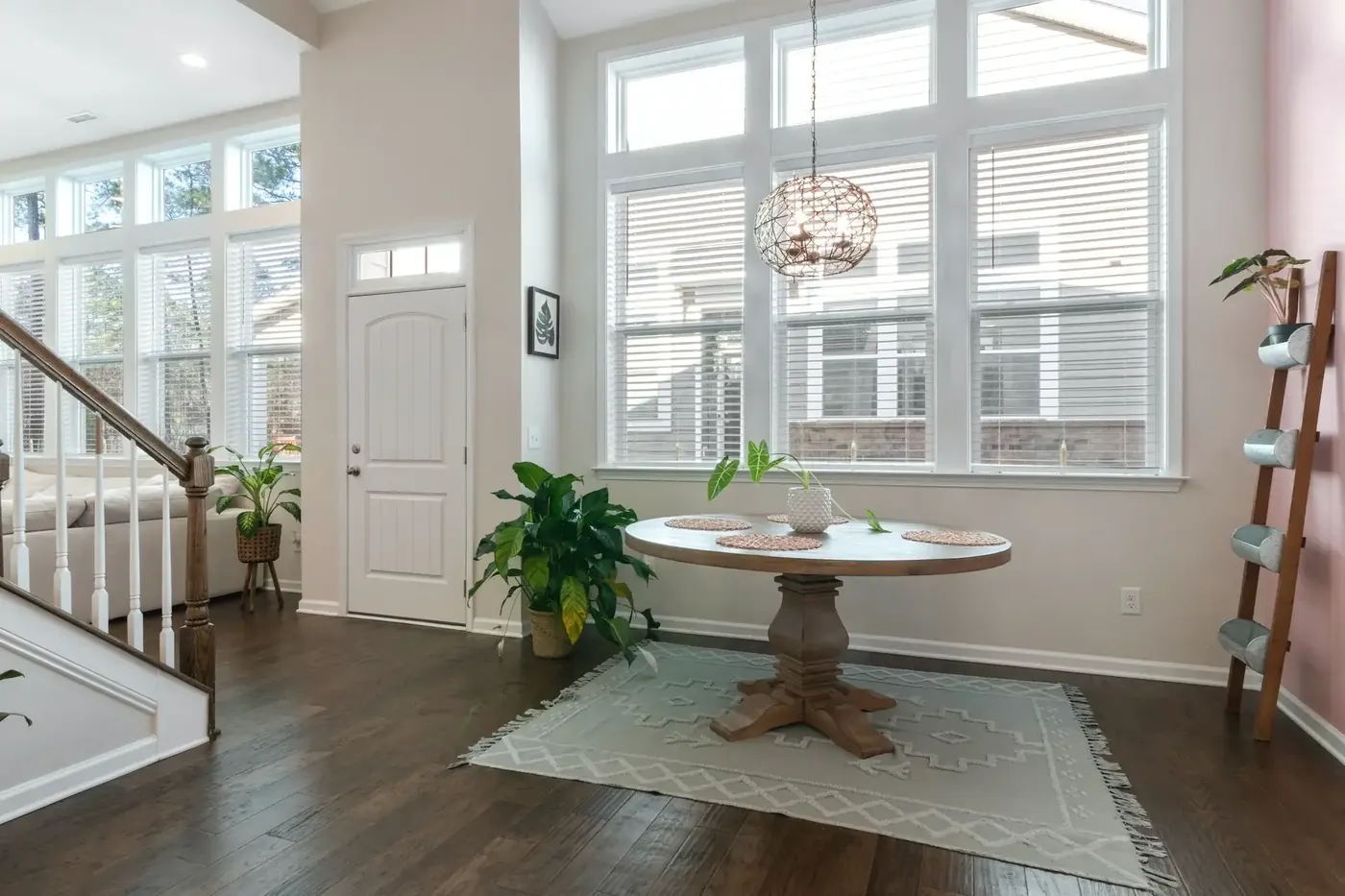
Take the great room wall in a Westfield house apart into pieces instead of pricing it as one line item. First, does the upper glass need covering at all. A comfortable, north facing room might not need it. A west facing room that's unusable by mid-afternoon has its entire problem sitting in that upper band. Second, operation, since nothing eighteen feet up moves by hand, motorization is simply how it gets run.
Battery motors cost roughly $100 to $300 a window less than hardwired ones, which is tempting until you remember a battery wand commonly needs fresh batteries about once a year, and this particular wall needs a lift to reach. If the walls are still open, running power now avoids that chore for good.
One giant shade also tends to underperform two smaller ones. Very tall shades give up more at the edges, and one major manufacturer notes bigger light gaps on shades 120 inches and taller or near a four to one height to width ratio. An upper band and a lower band, run independently, usually behave better. Solar fabric handles most view walls well, and openness factor, roughly one to ten percent, is the spec that trades glare control against how much view survives.
A new build rewards patience more than speed. Wait for the punch list, order the privacy rooms first, and let the rest follow once you've lived in the house a while. Westfield Window Treatments writes every scope and price down before ordering, as Indiana law requires on jobs over one hundred fifty dollars, so a new Westfield homeowner always knows what they agreed to. We're insured and bonded. Call (317) 863-9966 when your trim is finished.
Frequently Asked Questions
When should window coverings be measured in a new build?
After the drywall is up and the trim and paint are finished, and ideally after the punch list is closed. Plan dimensions describe framing intent, not the finished opening you'll actually cover. Drywall thickness, corner bead, trim reveal, and paint all stack up, and an opening the plan calls thirty six inches can finish anywhere across a range. Builders also adjust trim after the walkthrough, so a measure taken earlier can go stale. Drapery is the exception and gets measured after the finished flooring is in.
Are builder blinds bad?
No, they're a stock product cut down on site, and they work fine as a starting point. What they aren't is tailored. A machine on site shortens the headrail and trims the slats and bottom rail, which leaves a cut edge rather than a factory one, and the hardware inside the headrail doesn't recenter when the rail gets shorter. You usually get one white and one light filtering fabric for the whole house. That's fine in a secondary room and thin in a bedroom you want genuinely dark.
Do I have to do the whole house at once?
Not at all, and most people shouldn't. Cover the rooms that need privacy before you move in, bedrooms, bathrooms, the front rooms, and anything at eye level from the street. Use inexpensive temporary paper shades everywhere else. Then do the rooms you actually live in, and leave drapery and decorative treatments for last. Living through one season tells you which windows are punishing, and that's information no showroom appointment can give you.
 Blind Repair in Westfield: What Actually Breaks and Why
 Do You Need Blackout, or Will Room Darkening Get the Job Done
 Do Your Westfield Windows Need Inside Mount or Outside Mount Blinds?