Top-Down Bottom-Up Shades

Top-Down Bottom-Up Shades in and Around Westfield, IN

Two lift paths, twice the hardware, exactly the right geometry

Call (317) 863-9966Get Free Quote
Quick Answer

A short orientation before the detail: this product gets measured in your home, built to those sizes, and installed once it arrives. The answers here cover selection, operation, care and what the warranty does and doesn't include.

  • Service: Top-Down Bottom-Up Shades for Westfield homeowners
  • Service area: Westfield, IN and surrounding areas
  • How soon depends on which job it is. A new custom order waits on fabrication, typically two to five weeks after the measure. A repair like a restring or a cord lock doesn't wait on anything.
  • Insured and bonded
  • Serving Westfield, IN since 2008
Top-Down Bottom-Up Shades Services

Expert Top-Down Bottom-Up Shades for Westfield Homes

Top down bottom up matters most where the glass sits at the height a person walks past, and Kimblewick by Del Webb is exactly that condition. Of 491 houses on the former Claiborne Farms tract off 151st Street, 375 are recorded at a single story, so bedrooms and the gathering room present their windows at sidewalk level. The streets are named for racehorses, Affirmed, Barbaro, Ruffian and Northern Dancer, and every house there was built between 2021 and 2025 on cleared farm ground with nothing yet grown tall enough to screen anything. Running the fabric down from the head rather than up from the sill is the geometry that suits it.

The cost of that geometry is hardware. A top down bottom up shade carries two independent lift systems inside one headrail, a middle rail that has to stay level through its travel, and roughly twice the cord path of a standard shade. More parts means more to fall out of adjustment, and a middle rail hanging slightly off level is the most reported issue on the product. It's usually adjustment rather than failure. You also give up clear glass permanently, because the stacked fabric has to sit somewhere at both ends of the travel and it can't disappear.

When to Call

Signs You Need Top-Down Bottom-Up Shades

If you notice any of these in your Westfield home, it is worth booking a measure. None of it is urgent, and none of it fixes itself either.

Plants on the sill need light the shade blocks

West glass overheats the room by early afternoon

A home office needs light on the ceiling, not the screen

A dual-rail shade hangs crooked at one end

The clear band of glass came out smaller than expected

A bath window looks straight at a neighbor's wall

Motorized rails have both gone dead within a year

The dining table sits below a window at street level

Woven wood in the bath has swollen and sticks

The front room faces a sidewalk at eye level

Our Process

How Westfield Window Treatments Handles Top-Down Bottom-Up Shades

Every job follows the same five-step process. Transparent, thorough, and done right the first time.

1

Daily rail positions talked through

2

Brackets set level, shade hung

3

Both rails cycled twice

4

Top-down only offered as the simpler option

5

Rail straightening shown at handover

Real Project Photos

Top-Down Bottom-Up Shades in Westfield

Photographs from real top-down bottom-up shades jobs completed by our crew in Westfield and surrounding areas.
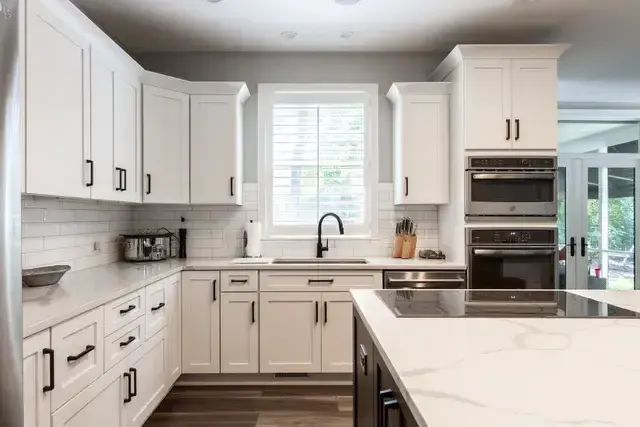
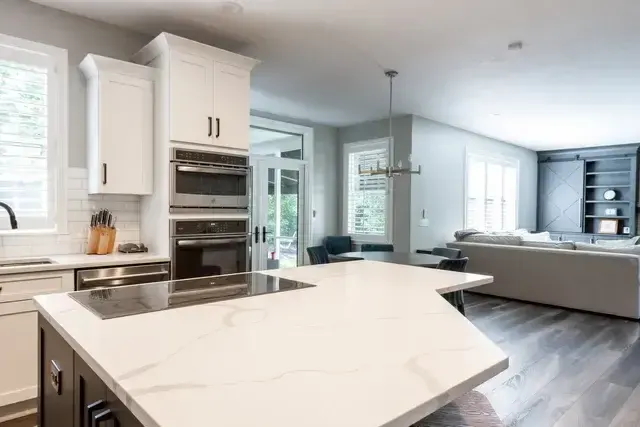
Custom shades measured and installed in WestfieldPlantation shutters fitted to a Westfield windowCellular shades in a Westfield living room
Scope of Work

What Top-Down Bottom-Up Shades Includes

Every Westfield job is documented item by item. Here is what the crew covers.

The honest hardware count stated at the measure: two rails, two lift paths and more parts than a single-lift shade

Which rail you will actually use daily talked through, since most people live in one or two positions

The sightline from the sidewalk checked with you standing in the room, because that is what sets the useful top rail height

Both stacks accounted for, the one at the head and the one that gathers under a lowered top rail

Glass left visible in the middle calculated before the order, so the open band is what you expected

Mounting depth measured for a deeper headrail, since two lift systems take more room than one

Three widths and three heights at every opening, with the diagonal read for square

Corded and cordless compared honestly, including how each one behaves when a rail drifts out of level

Cordless specified in rooms children use, since a corded dual-rail shade puts more cord in the room, not less

ANSI/WCMA A100.1-2022 cord access applied per opening rather than as one blanket line

Fabric opacity settled in writing, and the rail gap disclosed for anyone expecting blackout

Product family chosen for the room, cellular, pleated, a fabric fold or a woven natural

Weight checked against the finished size, because two rails and two lift paths add up on a wide unit

Light gap per side written on the paperwork, with the top rail position noted where it changes what you see

Rail leveling shown to you at handover so a drifted rail is a thirty second fix rather than a service call

Every opening in a room ordered together so fabric and hardware come off the same run

The contract written out in full, since IC 24-5-11 applies to residential work over $150 in this state

Both rails cycled through full travel at every window before we leave, top and bottom, twice

Pricing

What Top-Down Bottom-Up Shades Cost in Westfield

Published national ranges put custom-fabricated shades at roughly $250 to $2,600 a window, with motorized units at roughly $300 to $1,500 per window installed. Those are national category figures rather than a quote for anything in Westfield. A top-down bottom-up shade prices above the same shade with a single lift, and the reason is straightforward: you are buying two lift systems, a second moving rail and the hardware that carries both. Expect the upgrade to be real rather than nominal. The fabric decision then applies as usual, since a blackout cellular costs more than a light filtering pleated. Adding a motor to a dual-rail shade costs more than motorizing a single-lift one, because there are two things to move. Westfield Window Treatments prices from measured openings across Hamilton County.

By Product

How Top-Down Bottom-Up Shades Differ by Product

Every product in this trade behaves differently in a room. Here is what that means for this work.

Corded dual-rail lift: Two separate cord sets, one working the bottom rail and one working the top. It gives precise control of both rails and it puts the most cord and the most hardware into the window of any version we hang.

Cordless dual-rail lift: A spring system for the bottom rail and a second arrangement for the top, with nothing hanging beside the window. You move each rail by hand at the rail itself, which is what we specify wherever children are in the house.

Motorized dual-rail: A motor for each rail, so both positions are set from a remote or a keypad. It's the version that gets used daily on high or hard-to-reach windows, and it doubles the motor count, which shows up in both the price and the battery schedule.

Cellular top-down bottom-up: The most common build, because the cell structure stacks tightly at both ends and the fabric hides the second rail well. It's also the family with the DOE and ORNL energy testing behind the material itself.

Pleated top-down bottom-up: The lower cost version, with a single layer of pleated fabric rather than cells. It behaves the same way at both rails and gives up the trapped air pocket, which is worth saying plainly rather than leaving implied.

Fabric fold top-down bottom-up: A Roman-style shade with a movable top rail, so a formal room gets the same privacy trick without looking like a technical product. Folds stack deeper than cells, so the middle band of visible glass is narrower.

Woven natural top-down bottom-up: A bamboo or grass weave built with two rails. It looks striking and it stacks deepest of anything here, since natural material bundles rather than folds flat, so the finished size gets checked against the maker's limits first.

Room darkening fabric on a dual rail: A dense fabric on both rails, which gets a bedroom dim. The honest limit is where the two stacks meet under a lowered top rail, since that junction is hardware rather than a sealed edge and it passes a line of light.

Deeper headrail: The headrail on a dual-rail shade is larger than the one on a single-lift shade, because it houses two systems. That extra depth is the thing that most often turns a planned inside mount into an outside mount, so we measure for it early.

Outside mount with a real overlap: Mounted above and past the opening so the fabric laps the trim. On this product it does something specific: it lets the top rail drop below the head of the glass without exposing a lit gap at the sides of the opening.

Light Control

See What Each Fabric Does To The Light

Pick a fabric below and the window updates. It's a drawing rather than a photograph, so read it as a rough guide to what each family does in a Westfield room, and to what it doesn't do.

Fabric type

Sheer, 10 percent openness

Ten percent of the weave is open, so you keep the view and most of the daylight. Glare drops a little. After dark, once your lamps are on, someone outside can read shapes through it, which is why this belongs on a view window rather than a bedroom.

Openness factor is printed on the fabric card, so you can compare one line against another before you order anything.

Keeps the viewNot private after dark

Solar, 5 percent openness

The usual pick for a west window or a covered porch. You can still read the yard through it, glare comes down noticeably, and the fabric intercepts a good share of the sun before it reaches you at four in the afternoon.

It also cuts the UV landing on floors and furniture. NFRC puts UV at roughly 40 to 60 percent of fading damage, so this slows fading rather than stopping it.

View and glare controlSlows fading

Solar, 3 percent openness

A tighter weave. The room goes dimmer and the view drops back to an outline. Choose it where the sun is the problem and the view is second, which around here usually means a west wall in July. That's a common call on this side of Indianapolis.

Openness affects how much you see out, not how private you are. A 3 percent fabric still shows silhouettes at night.

View becomes an outlineStrong glare control

Solar, 1 percent openness

Close to a solid fabric with a little view left in it. This is the strongest glare control in the solar family.

The trade is that it darkens the room on a gray January day too. Indianapolis averages a January high near 36F and the light is flat, so think about how the room reads in both seasons before you commit.

Darkest solar optionDim on gray days

Light filtering

No view through it. Daylight comes through the face diffused, so the room stays bright without a hot spot across the television or the kitchen island. This is the default for living spaces.

It isn't private in reverse at night. With the lamps on and the sun down, silhouettes still show.

No view through itBright without the glare

Room darkening

A denser fabric, usually with a liner behind it. Most of the light coming through the face is gone.

Light still arrives around the edges on an inside mount, so a room darkening shade gives you a dim room rather than a dark one. If someone in the house sleeps during the day, say so at the measure and we'll scope it differently.

Dim, not darkEdges stay bright

Blackout

The fabric itself passes essentially no light. What you'll still see is the perimeter. Lutron publishes an inside-mount light gap of about 3/4 inch per side on its Roller 20 and 64 shades, along with a standard factory deduction of 1/16 inch per side, and shades over 120 inches tall or past a 4:1 height-to-width ratio get larger gaps than that.

So if you need a genuinely dark bedroom, that gap has to be dealt with on purpose, either with side channels or by going outside mount. We tell you which one your opening can carry while we're still standing in the room.

Dark facePerimeter needs a plan

Openness factor is a measured fabric spec, so you can compare it line to line. The category names are not measured. One maker's room darkening can behave like another maker's light filtering, which is why the sample books come to the measure and get opened in the room they're going in, at the hour that room has the problem.

Common Questions

Top-Down Bottom-Up Shades FAQ

Questions we hear most often from Westfield homeowners considering top-down bottom-up shades.

In street facing rooms, usually yes. On a single level plan every window sits at the height of somebody walking or driving past, so the choice is normally between a covered window and a dark room. Dropping the shade from the top covers the sight line and leaves daylight arriving above it, which is the whole argument. In a rear bedroom facing an empty back yard it isn't worth the difference, and we'd fit a plain cordless shade there instead. We'd rather specify it on the four windows that need it than on every opening in the house.
Almost always cord tension rather than damage. The middle rail is carried on a pair of lift cords, and if one has taken up slightly more travel than the other, the rail sits low at one end. Most product lines have an adjustment at the headrail or at the rail itself, so it's a service visit rather than a replacement. It gets worse if the shade is operated by grabbing one end of the rail instead of the center, which is how most people do it without thinking. We show you the right way at the install and it genuinely makes a difference.
More than a standard shade, because there are two stacks rather than one. Raised fully, the fabric bundles at the head as usual. Lowered fully from the top, it bundles at the bottom. In between, both stacks exist and both sit over glass. The practical effect is that the fully open view is slightly smaller than the same shade without the top down function. On a short window that loss is proportionally larger, which is why we measure the stack allowance against your actual opening rather than quoting a catalog number at you.
On several product lines, yes, and it costs more than motorizing a single lift because there are two paths to drive. Some lines motorize only the bottom rail and leave the top manual, which is a compromise worth understanding before you buy, since you get automation on the function you use less. Where a top down bottom up shade is high or hard to reach, motorizing both is the right answer and the price reflects it. On a single story plan where every shade is within reach, the manual version usually makes more sense and the money goes further elsewhere.
Cellular is the most common and the best behaved, because the fabric collapses tightly at both ends and the hardware is well developed. Pleated and Roman shades are widely available in the configuration. Woven wood and bamboo can be done on most lines, with the liner adding stack. Roller and dual shades essentially can't, because a roller has one tube and nowhere for a second stack to live. If you want the function on a window where a roller is the right product, the workable route is two shades in one opening rather than one clever one.
It can be, and the lift type decides it. Cordless top down bottom up exists on most current lines and is the specification to ask for in any room a child uses. Some older or lower cost versions of the function still use accessible operating cords, and a shade with two lift paths has more cord in it than a standard one. Products conform to ANSI/WCMA A100.1-2022, which is a product standard rather than something a company holds, so the right question at the quote is which lift the specific product uses.
One shade, two moving rails. The bottom rail lifts the way any shade does. The top rail comes down from the head of the window, so you can drop it a foot and let daylight in over the top while the lower glass stays covered. That's the whole idea: light from above, privacy below. In a front room on a sidewalk in Westfield, or a bath on a side elevation looking at a neighbor, it solves a problem that no single-rail shade solves.
You're buying two lift systems instead of one, plus a second rail and the hardware that carries it. That's not a small upcharge and we'd rather you hear the reason than the number alone. Nationally, custom shades run about $250 to $2,600 per window, and a dual-rail build sits meaningfully above the same shade with a single lift. Motorizing one costs more than motorizing a standard shade too, since there are two things to drive.
More hardware, more to fail. A corded version runs two separate cord paths through the shade, which means twice as many cords to fray, twice as many places to bind, and a restring job that's genuinely more involved. Cordless versions have two spring or friction systems that can wear at different rates. Neither of those is a reason to avoid the product. They're a reason to buy a good one, specify cordless where you can, and know what you're living with.
Cordless in any room children or pets use, and it isn't close. A corded dual-rail shade puts more operating cord in the room than a standard shade does, which is the opposite direction from where ANSI/WCMA A100.1-2022 points on cord access, and inner-cord non-compliance is treated as a substantial product hazard under 16 CFR 1120.3. Corded gives finer control of the top rail from across the room. In a bedroom or a nursery that isn't the trade we'd make.
Usually not to the sill, and the reason is fabric. As the top rail drops, the fabric above it has to gather somewhere, so a stack builds under the rail and grows as it comes down. On most products the top rail travels most of the drop and stops with a stack still hanging below it. On a woven natural or a fabric fold, where the material bundles deeper, it stops sooner. We show you the real travel rather than the marketing photo.
Both ends, and it's worth knowing before you order. With the shade fully raised you have the head stack. With the top rail dropped, you have that stack hanging under the rail plus the bottom stack sitting above the sill. The band of clear glass in the middle is what you're actually buying, and on a short window it can be narrower than people picture. Cellular stacks tightest. A woven natural stacks deepest. We calculate it at the measure.
It can be dim in a room darkening or blackout fabric, and it can't be sealed. There's a rail where the top section meets the fabric, and that junction is hardware, so it passes a line of light no matter what the fabric does. Add the side gaps of an inside mount, where Lutron publishes 3/4 inch per side as a real figure on their roller product, and you can see why a dark bedroom wants a different build. If a room must be dark, we layer or we mount outside with real overlap.
Usually not. On a corded shade, one side of a cord path can take up more travel than the other, and the rail ends up sitting a little low at one end. The fix is to pull the low corner down gently and let it re-seat, then run the rail full travel. We show every customer that at handover because it takes half a minute and it saves a service call. If it drifts again within a day or two, something is binding, and that we come and look at.
Rooms where you want daylight and you don't want the street. Front-facing living rooms on a sidewalk. Bathrooms on a side elevation looking straight at a neighbor. Kitchen windows over a sink where the yard is fine to see but the driveway isn't. Home offices where you want light on the ceiling and not on a screen. It's a specific answer to a specific problem, and in a back bedroom facing a wooded lot it's money you don't need to spend.
Cellular and pleated are the most common, since both stack tightly and handle a second rail cleanly. Fabric fold shades can be built this way and look lovely doing it, with a deeper stack as the tradeoff. Woven naturals can too, and they stack deepest of all. Rollers cannot, because a roller has nowhere for a second stack to go. If you've seen a roller doing something similar, it was two shades on a dual bracket, which is a different product.
More than a single-lift shade wants, yes, because the headrail houses two systems. This is the detail that most often turns a planned inside mount into an outside mount, and we measure it at the top of the opening before anything gets ordered. Where the depth isn't there, mounting outside the opening with a proper overlap is a better result than a headrail standing proud of the trim, and it usually improves privacy at the edges too.
Sometimes in the field, often at the factory, and always more involved than a single-lift shade. There are two cord paths running through the shade, so a restring means working out which path failed and threading it back through the fabric correctly. On a cordless unit, a failed lift is usually a headrail component rather than a cord, and that's typically a factory part. We'll tell you honestly which side of that line your shade falls on before you decide to repair or replace.
Yes, with two motors, one per rail, and the cost reflects that. It's the version that makes sense on tall or hard to reach windows in Hamilton County, where reaching a top rail by hand means standing on something. Installed motorization sits nationally at $300 to $1,500 per window and you're driving two rails. Batteries are the recurring cost, and Hunter Douglas states PowerView battery life is about one year, which on a dual-rail shade means two battery changes rather than one.
Two to five weeks is the usual custom fabrication window and dual-rail units generally sit toward the longer end, since the second lift system gets built and tested at the factory. Motorized versions add a step. That fabrication window goes into your paperwork with the scope, the dates and the total price, which the Indiana Home Improvement Contract Act requires on residential work over $150.
Areas We Serve

Top-Down Bottom-Up Shades Across Westfield

We measure and install in every one of these Westfield neighborhoods. Each has its own page with the build eras, window conditions and mounting notes for that section.

Free In-Home Measure

Schedule Your Free In-Home Measure in Westfield

Contact Information

Reach Us Directly

Our team prioritizes scheduled measures and service calls, and books in-home measures during business hours.

Office
1417 Commerce Avenue, Indianapolis, IN 46201
Hours
Mon-Fri 8a-6p
Service Area
Westfield, IN and Surrounding Areas

Ready to Book Your Measure?

Call us to set up an in-home measure, or to ask about a treatment that has stopped working. We will talk it through on the phone first.

Service area

Serving Westfield and the surrounding area

Call NowGet Quote