Blackout Shades Serving Westfield, IN
Dark is a mounting decision, not a fabric name
These are the questions we field most often about this product. Several of the answers include a caveat. That's deliberate, because a caveat before the sale is far cheaper than a complaint after one.
- Service: Blackout Shades for Westfield homeowners
- Service area: Westfield, IN and surrounding areas Two different timelines apply. New custom product takes weeks because it has to be made. Repairs to what's already hanging, a cord lock, a ladder string, a chain that jumped the clutch, are usually far quicker.
- Insured and bonded
- Serving Westfield, IN since 2008
Expert Blackout Shades for Westfield Homes
This is the product with the largest gap between what people expect and what they get, and the gap is almost never the fabric. A blackout fabric blocks light through itself. It does nothing at all about light coming around the edges, and on an inside mount there's always light coming around the edges, because the shade is fabricated narrower than the opening so it can operate. An inside mounted blackout shade is a dark shade with two bright lines beside it, and that's the single most common expectation failure in this trade.
The Westfield version of the problem has a specific shape. In a subdivision built on former farm ground with no canopy, a primary bedroom takes low summer sun early and late, plus street lighting from a road with new fixtures and no trees to interrupt them. There's nothing outside doing any of the work. So the specification has to be genuinely light tight rather than nominally so, which means an outside mount with real overlap, or side channels, or a light blocking pocket at the head, and usually more than one of those.
The good news is that a modern Westfield opening makes the honest version easy to detail. Square set drywall with no casing means an outside mounted shade on a header board doesn't have to fight a decorative trim profile or sit awkwardly over a cased opening. It reads as a clean rectangle above and beside the glass, which suits the architecture, and it delivers the result somebody actually asked for.
Signs You Need Blackout Shades
If you notice any of these in your Westfield home, it is worth booking a measure. None of it is urgent, and none of it fixes itself either.
Light down both sides of the existing shade wakes you
A bedroom faces east or west with nothing shading it
A child naps in daylight and the room is too bright
Street lighting reaches the bedroom on a bare lot
A media room washes out during the day
Existing blackout blinds glow at the edges at night
Somebody in the house sleeps through the daytime
Pinpoints of light show through a blackout shade
How Westfield Window Treatments Handles Blackout Shades
Every job follows the same six-step process. Transparent, thorough, and done right the first time.
Define what dark means
Dark enough for a nap and dark enough for a night shift worker are different specifications and different prices. We ask exactly what result you need before recommending anything, because the difference between them is side channels and a head pocket. Getting this wrong in either direction wastes money or wastes the whole order.
Rule out the inside mount
If the answer needs to be genuinely dark, we say plainly that an inside mount will not do it, and we say it before you've picked a fabric. The gap is a physical requirement of the product operating, not a quality issue. Lutron publishes three quarters of an inch per side on its Roller 20 and 64 systems as the baseline for that clearance.
Specify overlap or channels
Two routes work. An outside mount with generous overlap onto the wall each side and above, which is the simpler and cheaper answer and is easy to detail on a square set opening. Or an inside mount with side channels running the drop and a light blocking pocket at the head, which is neater and costs more. We price both and let you choose.
Handle the head and the sill
Light comes over the top as readily as around the sides. A cassette with a light blocking pocket closes the head. At the bottom, a hem sitting slightly proud of the sill on an outside mount closes the last line. These two details are what separates a shade that works from one that's simply dark colored.
Consider the condensation risk
Blackout linings and tight side channels are exactly the conditions where winter condensation on the glass has nowhere to go, and moisture wicks into hems and cells. In a Westfield house still drying out through its first heating season this is a real risk. We say where it applies and how to vent the shade occasionally in the coldest months.
Install, then test the darkness
Brackets level, full travel run, and then the test that matters: the room checked with the lights out and the shade down, in daylight, so you can see exactly where light is still getting in. Any remaining leak gets identified while we're standing there rather than reported at six the following morning.
Blackout Shades in Westfield
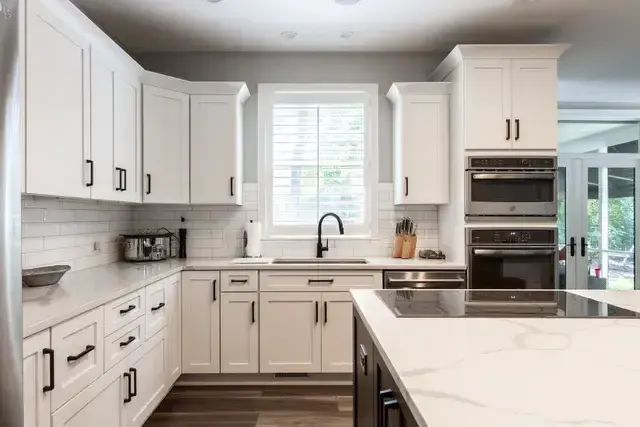
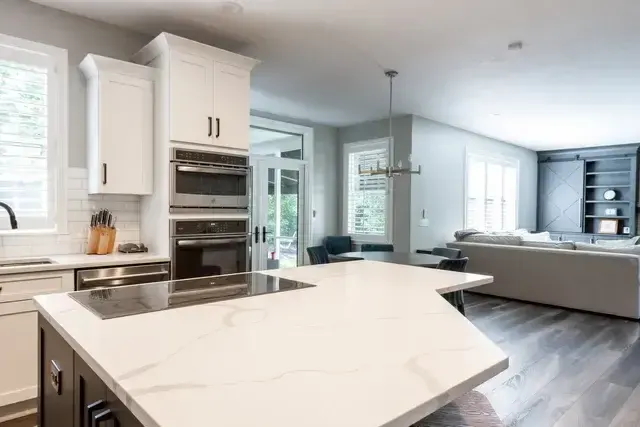
Photographs from real blackout shades jobs completed by our crew in Westfield and surrounding areas.
What Blackout Shades Includes
Every Westfield job is documented item by item. Here is what the crew covers.
The actual goal settled first, since a room dark enough to sleep in and a genuinely dark room need different products
Every opening measured and checked on the diagonal, because a shade hanging out of level leaks down one side
Outside light sources logged at the measure: a street lamp, a security light, headlights sweeping a bend
Wall surface above and beside the opening checked for somewhere flat and solid to land channels
Outside mount specified wherever real darkness is the goal, with overlap written in inches on every side
Side channels specified where the room has to be dark and the wall around the opening will take them
A light-blocking pocket or a closed cassette specified at the top so daylight can't come over the roller
Factory deduction disclosed up front, since Lutron publishes 1/16 inch per side and that width has to go somewhere
Inside-mount light gap stated in writing, using Lutron's published 3/4 inch per side on Roller 20/64
Tall or narrow units flagged, because shades past 120 inches or a 4:1 height-to-width ratio get larger gaps
The bottom of the shade addressed on its own: hembar position, sill depth and light bouncing off the sill
Fabric named honestly as room darkening or blackout on the order, because the two aren't the same thing
Seam construction checked on any fabric going into a room that has to be dark, so needle holes don't become pinholes of light
Wall and ceiling color discussed, since a bright white room bounces whatever daylight does get past the shade
Cordless or motorized lift specified in nurseries and kids' rooms, to ANSI/WCMA A100.1-2022
Layering planned where one product can't finish the job, such as a blackout roller under lined panels
Channels fastened plumb down both sides, since a bowed track opens a gap of its own
The finished shade run through full travel and looked at with the room lights off, in daylight, before we leave
What Blackout Shades Cost in Westfield
National figures put stock shades at roughly $60 to $600 per window and custom-fabricated shades at roughly $250 to $2,600 per window. Those are national ranges for a category and not a quote for a bedroom in Westfield. Blackout has a wrinkle the other categories don't: the fabric is rarely the expensive part. Getting a room actually dark means an outside mount with real overlap, side channels down both sides and a pocket or closed cassette at the top, and that hardware can cost as much as the shade it surrounds. A bare blackout roller is cheap and it will disappoint you. Westfield Window Treatments prices the whole assembly for Hamilton County rooms, because pricing the fabric alone is how customers end up unhappy.
How Blackout Shades Differ by Product
Every product in this trade behaves differently in a room. Here is what that means for this work.
Blackout roller shade: A dense coated fabric on a tube, the workhorse of this category. The cloth itself passes essentially no light. Everything about whether the room goes dark comes down to what you put around the edges of it, not the fabric you picked.
Blackout cellular shade: A honeycomb with a blackout layer inside the cells, which adds an insulating air pocket the roller doesn't have. It's the better choice on a cold bedroom window in January, and it pairs with side tracks the same way a roller does.
Side channels: Aluminum or vinyl tracks running down both sides that capture the fabric edge. This is the single component that turns a dark shade into a dark room. They're visible, they add width to the outside of the opening, and they need a flat mounting surface.
Light-blocking pocket: A three-sided box mounted above the shade that closes off the top and the upper corners. Light comes over a roller as easily as around it, and a pocket is what shuts that path without relying on the fabric wrapping the tube.
Closed cassette: A headrail enclosing the roller on all sides with a fabric slot at the bottom. It handles the top gap the way a pocket does while looking like finished hardware rather than a built element, and it suits a wall with no depth above.
Outside mount with overlap: Mounting past the trim on all four sides, so the fabric covers more than the opening. The cheapest real improvement in this category. Two or three inches of overlap per side does more for darkness than upgrading the fabric ever will.
Room darkening fabric: A fabric that cuts most light without being opaque, usually with a soft glow through the cloth. It's enough for a guest room or a den, it costs less, and calling it blackout is the most common mislabeling in this trade.
Dual shade on one bracket: A solar screen and a blackout shade on a single bracket set, operated separately. You keep the view and glare control during the day and drop the blackout at night, which is how a bedroom that's also a sitting room gets solved.
Motorized blackout: A motor lets a channeled shade run its full travel without anyone fighting a track, and it puts a dark room on a schedule. On battery, expect to change or recharge roughly once a year, which is the cost nobody mentions at the sale.
Blackout lined drapery over a shade: Panels handle the softness and the sides while the shade handles the glass. The combination reaches a level of darkness neither one gets to alone, and it's often the better-looking answer in a primary bedroom.
See What Each Fabric Does To The Light
Pick a fabric below and the window updates. It's a drawing rather than a photograph, so read it as a rough guide to what each family does in a Westfield room, and to what it doesn't do.
Openness factor is a measured fabric spec, so you can compare it line to line. The category names are not measured. One maker's room darkening can behave like another maker's light filtering, which is why the sample books come to the measure and get opened in the room they're going in, at the hour that room has the problem.
Blackout Shades FAQ
Questions we hear most often from Westfield homeowners considering blackout shades.
Blackout Shades Across Westfield
We measure and install in every one of these Westfield neighborhoods. Each has its own page with the build eras, window conditions and mounting notes for that section.
Other Window Treatment Services in Westfield
Westfield Window Treatments handles the full scope of window treatment work. Explore our other services below.
Schedule Your Free In-Home Measure in Westfield
Reach Us Directly
Our team prioritizes scheduled measures and service calls, and books in-home measures during business hours.
Ready to Book Your Measure?
Call us to set up an in-home measure, or to ask about a treatment that has stopped working. We will talk it through on the phone first.