Cellular Shades in Westfield by Westfield Window Treatments
Measured on two seasons, stacked where the head allows
Here's the detail behind the product description. What it's made of, how it's sized, what drives the price, how long it takes to build and what the manufacturer covers if it fails.
- Service: Cellular Shades for Westfield homeowners
- Service area: Westfield, IN and surrounding areas Honest structure: the measure happens on a normal appointment, the factory takes two to five weeks to build your order, and then we install. Service work on something already hanging moves much faster because nothing needs fabricating.
- Insured and bonded
- Serving Westfield, IN since 2008
Expert Cellular Shades for Westfield Homes
Cellular is the one product on this list with published test data behind it. Department of Energy and Oak Ridge National Laboratory testing found cellular shades saved up to 20 percent on heating energy and up to 15 percent of total heating and cooling energy against a bare window, measured at an ORNL test house and modeled across fifteen climate zones. That's a measured result rather than a promise about your utility bill, and it's worth knowing what it comes from before anybody quotes you a number.
It matters here because central Indiana genuinely has both loads. January averages a low of 20.9F over a cold season of about three months, and July averages a high of 85.2F over a muggy season running from late May to late September. A single product being defensible on both seasons is unusual, and the honeycomb structure is why: the cells trap a still air layer against the glass, which works the same way regardless of which direction the heat is trying to go.
In a Westfield house the second reason to choose cellular is usually top down bottom up. Lot sizes in the production communities run tight, 0.10 to 0.40 acres in Harmony and Centennial, so front rooms sit close to a sidewalk and a street. Dropping the top of a shade rather than raising the bottom gives you daylight across the ceiling and privacy at eye level, which is exactly the problem on a narrow lot. It puts a second operating system on every shade, so it costs more, and on the right window it's the reason the product wins.
Signs You Need Cellular Shades
If you notice any of these in your Westfield home, it is worth booking a measure. None of it is urgent, and none of it fixes itself either.
A bedroom feels cold near the glass in January
A front room needs privacy without losing daylight
You want measured energy performance rather than a claim
Stack height is tight above a tall narrow opening
The room gets both a heat and a draft complaint
A nursery needs darkness and a soft product
Existing pleated shades have gone limp and dusty
Two seasons are both a problem in the same room
How Westfield Window Treatments Handles Cellular Shades
Every job follows the same six-step process. Transparent, thorough, and done right the first time.
Establish which season
The first question is whether the complaint is winter cold near the glass, summer heat, privacy, or all of them. Cellular answers all four to different degrees and the answer changes the cell count and the fabric tier. A room with a genuine winter problem gets double cell. A room where privacy is the actual driver gets a different fabric and possibly top down bottom up.
Choose single or double cell
Single cell is the base and it's plenty in a room that's simply bright. Double cell traps more air and does more against a 20.9F night, at more cost and more stack. We say plainly which rooms justify it rather than upselling the whole house, because in a bedroom that faces east and never gets cold the second cell is money doing nothing.
Check stack height
A cellular shade stacks at the head and that stack has real depth, more on a double cell and more again on top down bottom up. On a tall narrow opening, or where the head of the opening is close to the ceiling, the stack can cover glass you wanted. We measure the stack allowance against the actual opening and show you where the top of the glass ends up.
Decide the operating system
Cordless lift is the default and the right answer in any room a child uses. Top down bottom up adds a second system and a second set of hardware. Motorization is worth pricing where a shade is high, where there are many of them, or where grip strength is a consideration. Each of those changes the head detail, so it gets settled before fabrication.
Warn about condensation
Winter condensation on glass wicks into fabric hems and cell walls, and it's worst behind blackout linings and tight side channels. A house finished this year is still drying out through its first heating season, which makes this a live issue across a lot of Westfield. We say where an inside mount raises the risk and what mounting or venting reduces it.
Install and check the drop
Brackets level across the run, full lift and full drop tested several times, and the bottom rail checked parallel to the sill. On top down bottom up we run both systems through their travel with you watching, because the middle rail position is the thing people fiddle with and the thing that gets reported as a fault when it's actually adjustment.
Cellular Shades in Westfield
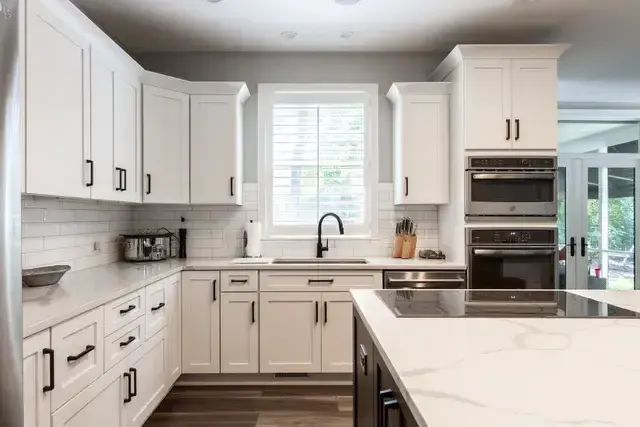
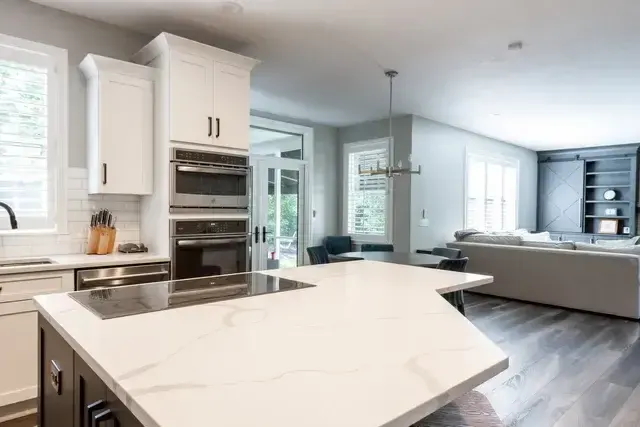
Photographs from real cellular shades jobs completed by our crew in Westfield and surrounding areas.
What Cellular Shades Includes
Every Westfield job is documented item by item. Here is what the crew covers.
Room-by-room walk to decide where the energy case is real and where it isn't
Three widths and three heights per opening with a diagonal square check
Mounting depth measured so the headrail sits fully inside the opening where an inside mount is wanted
Single cell or double cell specified per room rather than picked once for the whole house
Cell size chosen against the opening, smaller cells on short windows so the stack stays in proportion
Light filtering, room darkening and blackout fabrics separated in writing before anything is ordered
Top-down bottom-up specified where street privacy and daylight both matter at the same window
Cordless lift specified as the default in bedrooms, nurseries and stairwells
Continuous cord loop with a tensioner used only where weight or height makes cordless impractical
Products specified to conform to ANSI/WCMA A100.1-2022 for cord access
Winter condensation risk on tight inside mounts explained at the measure
Headrail clearance from the glass checked so the shade isn't sealed against a cold surface
Light gap per side disclosed for inside mounts and written on the paperwork
Vertical cellular units drawn where the opening is a slider rather than a window
Specialty shapes measured with a template where an opening is arched or angled
Wide spans reviewed for headrail deflection and split into two units where that's the right call
Bottom rail leveling and full travel tested at every unit on install day
Old product removed, brackets pulled and the wall left ready for the new mount
What Cellular Shades Cost in Westfield
National category numbers put stock shades around $60 to $600 per window and custom-fabricated shades around $250 to $2,600 per window. They're national ranges, published for the category, and they aren't a quote for any address in Westfield. Cellular sits across a wide part of that band because the construction varies so much. A single cell light filtering shade on a small opening is near the bottom. A double cell blackout shade with top-down bottom-up on a tall window is near the top, and it should be, since you're paying for two lift systems and a heavier fabric. Size, cell count, fabric opacity and lift type are the four levers. Westfield Window Treatments prices from measured openings in Hamilton County, not from a per-window average.
How Cellular Shades Differ by Product
Every product in this trade behaves differently in a room. Here is what that means for this work.
Single cell, 3/8 inch: The small cell keeps the stack tight at the top of the window, which matters on short openings and transoms. Specify it where you want the shade nearly gone when it's raised and the room isn't an energy problem.
Single cell, 9/16 inch: The everyday size. It gives you real cell depth without a heavy stack, and it covers most bedrooms, living rooms and offices. This is the default we start from unless a room argues for something else.
Double cell, 3/8 inch: Two rows of cells means two pockets of trapped air across the same opening. Choose it on the elevations that get hit hardest, which around here usually means the north wall in January and the west wall in July.
Double cell, 3/4 inch: The deepest construction we normally hang. It stacks taller and costs more, so we reserve it for tall windows on hard elevations where the energy argument does the work of justifying it.
Light filtering fabric: Daylight comes through diffused and the room stays bright without direct glare. It's the right call in kitchens, living rooms and any space where you want softness rather than darkness.
Room darkening fabric: A denser fabric, sometimes with a liner inside the cell, that cuts most of the light through the face. Bedrooms are the obvious use. Understand that an inside mount still passes light at the edges.
Blackout fabric: The heaviest option, with a light-blocking liner in the cell. Pair it with an outside mount or side tracks if the goal is a genuinely dark room rather than a dim one. On its own it darkens, it doesn't seal.
Top-down bottom-up: Two rails on independent controls, so you can drop the top for daylight while the bottom stays up for privacy. It earns its cost in bathrooms and in any room facing a sidewalk or a close neighbor.
Cordless lift: No lift cord anywhere on the shade. It's what we put in kids' rooms by default, and it's the cleanest thing to operate on a shade you touch every day. Wide units want a hand at each end of the rail.
Vertical cellular: The same honeycomb fabric running on a track for a patio slider, stacking to one side. It gives a sliding opening the insulating construction that a vertical blind can't, and it looks like fabric rather than hardware.
See What Each Fabric Does To The Light
Pick a fabric below and the window updates. It's a drawing rather than a photograph, so read it as a rough guide to what each family does in a Westfield room, and to what it doesn't do.
Openness factor is a measured fabric spec, so you can compare it line to line. The category names are not measured. One maker's room darkening can behave like another maker's light filtering, which is why the sample books come to the measure and get opened in the room they're going in, at the hour that room has the problem.
Cellular Shades FAQ
Questions we hear most often from Westfield homeowners considering cellular shades.
Cellular Shades Across Westfield
We measure and install in every one of these Westfield neighborhoods. Each has its own page with the build eras, window conditions and mounting notes for that section.
Other Window Treatment Services in Westfield
Westfield Window Treatments handles the full scope of window treatment work. Explore our other services below.
Schedule Your Free In-Home Measure in Westfield
Reach Us Directly
Our team prioritizes scheduled measures and service calls, and books in-home measures during business hours.
Ready to Book Your Measure?
Call us to set up an in-home measure, or to ask about a treatment that has stopped working. We will talk it through on the phone first.