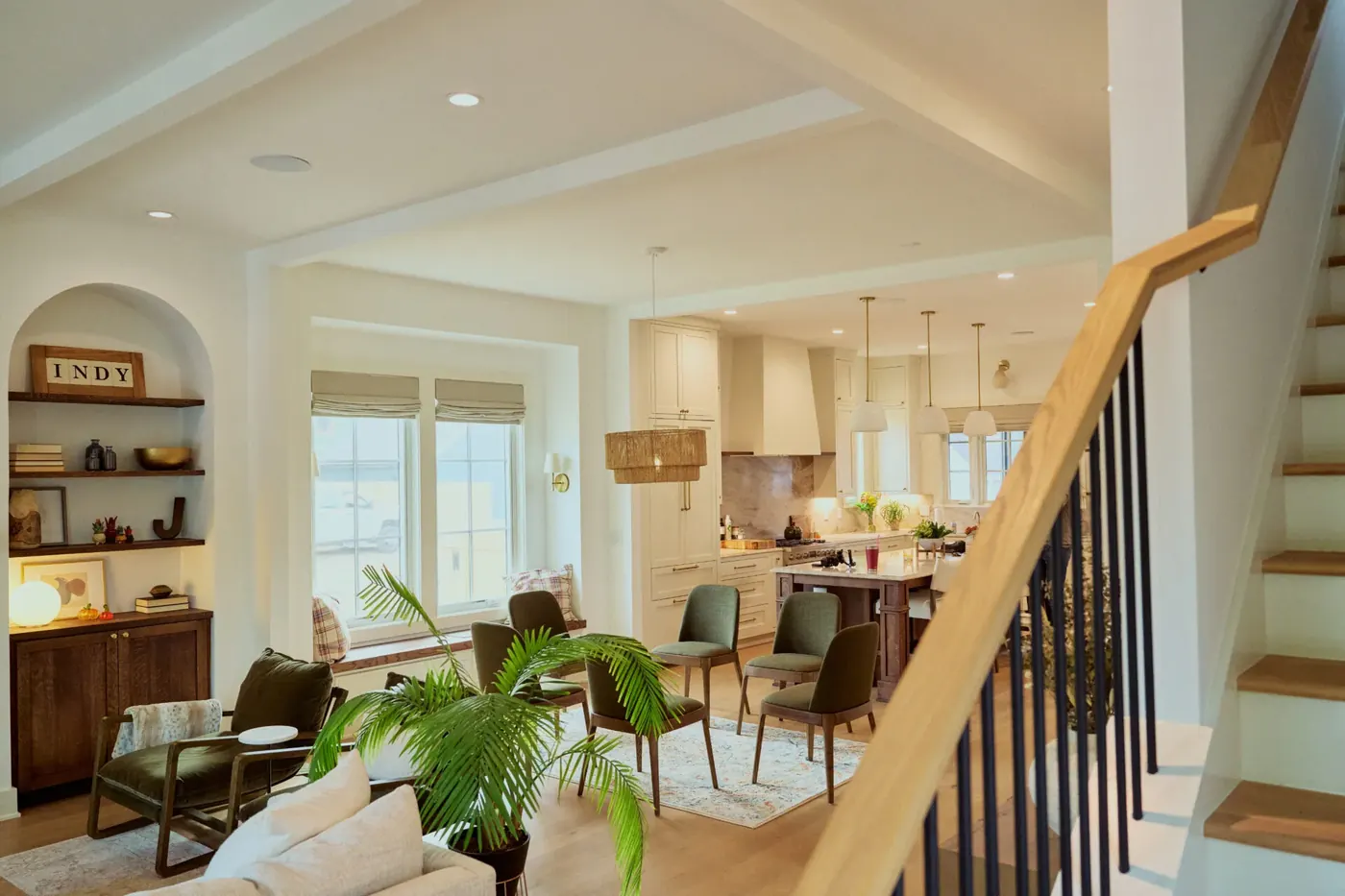
Valances & Top Treatments

Westfield Valances & Top Treatments

A top edge for windows the builder left untrimmed

Call (317) 863-9966Get Free Quote
Quick Answer

The questions below are the ones that come up during measures for this product. They're answered here so you can think about them before somebody is standing in your room waiting for a decision.

  • Service: Valances & Top Treatments for Westfield homeowners
  • Service area: Westfield, IN and surrounding areas
  • Nothing in this trade is an urgent call-out, so here's the real timeline. Measures get scheduled promptly at a time that suits you. Custom fabrication then runs roughly two to five weeks. Installation is a morning or a day.
  • Insured and bonded
  • Serving Westfield, IN since 2008
Valances & Top Treatments Services

Expert Valances & Top Treatments for Westfield Homes

A top treatment finishes the head of a window, and in Westfield it's most often solving one of two specific problems. The first is an exposed headrail. On a square set opening with no casing, the headrail of a blind or shade is a visible horizontal bar with nothing to relate to, and it reads as hardware rather than as part of the room. A valance covers it and gives the window a top edge. The second is a wide flat transom, which current elevations here use in place of the half round arches typical of the 1995 to 2010 generation.

Those wide transoms are a Westfield signature and they present a genuine design question. The transom is usually left uncovered, because covering it wastes the light it was put there to bring in, but that leaves the shade below finishing at an arbitrary line with a band of bare glass above it. A cornice or a fabric valance spanning both, mounted above the transom, ties the whole assembly together and gives the shade below something to finish against.

Top treatments come in a range from a simple fabric valance over a headrail through a structured cornice built on a board with buckram behind the face fabric. Pricing runs by the running foot rather than per window, which changes the arithmetic on a wide opening. They're decorative rather than functional, so they should be specified after the working treatment is settled, not before. A cornice over a shade that turns out to be the wrong shade is money spent twice.

When to Call

Signs You Need Valances & Top Treatments

If you notice any of these in your Westfield home, it is worth booking a measure. None of it is urgent, and none of it fixes itself either.

An exposed headrail reads as hardware in the room

A wide flat transom leaves the shade finishing nowhere

The window head looks unfinished against high ceilings

A room needs softness but not full drapery panels

Several windows in one wall need visual connection

A shade alone looks stark on a large plain wall

The top of a door wall needs a defined edge

Existing valances look dated against a modern elevation

Our Process

How Westfield Window Treatments Handles Valances & Top Treatments

Every job follows the same six-step process. Transparent, thorough, and done right the first time.

1

Settle the working treatment first

The shade, blind or shutter gets specified and agreed before any top treatment is designed, because the top treatment has to relate to it and cover its hardware. Doing this in the other order produces a cornice sized for a product that then changes, which is an expensive way to learn the sequence.

2

Choose the type

A soft fabric valance, a structured cornice on a board, or a wood or composite cornice matching the treatment below. Soft reads warmer and suits a room with other fabric in it. Structured reads more architectural and suits a modern square set opening. We show both against the actual wall, since scale is impossible to judge from a photograph.

3

Set height and projection

How deep the treatment sits from the wall and how far down it comes are the two dimensions that decide whether it looks right. It has to project far enough to clear the headrail and any stack behind it, and it has to be deep enough vertically to read as deliberate rather than as a strip. We mock it up with tape on the wall.

4

Deal with the transom

Where a wide flat transom sits above the window, we decide whether the treatment mounts above it, spanning both, or between transom and window. Above reads as one assembly and keeps the transom glass clear. Between splits the window visually and is occasionally the right answer where the transom is a strong feature on its own.

5

Coordinate the fabric

If drapery, Roman shades or upholstery are involved, the top treatment fabric gets chosen alongside them and ordered from one dye lot where it's the same fabric. Where it's a contrast fabric, we look at both in the room's own light. A cornice is a large area of a single fabric and it shows a color mismatch more clearly than a cushion does.

6

Install and check the line

Mounting boards anchored into structure, the treatment set level across its whole run rather than to each end, and then a look down the wall from the far corner. On a run of several windows, a top treatment that's a quarter inch off on one window is obvious in a way a single window would never reveal, so the whole wall gets sighted before we finish.

Real Project Photos

Valances & Top Treatments in Westfield

Photographs from real valances & top treatments jobs completed by our crew in Westfield and surrounding areas.
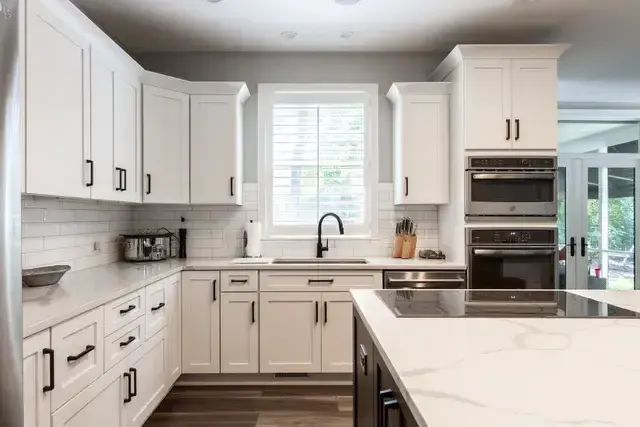
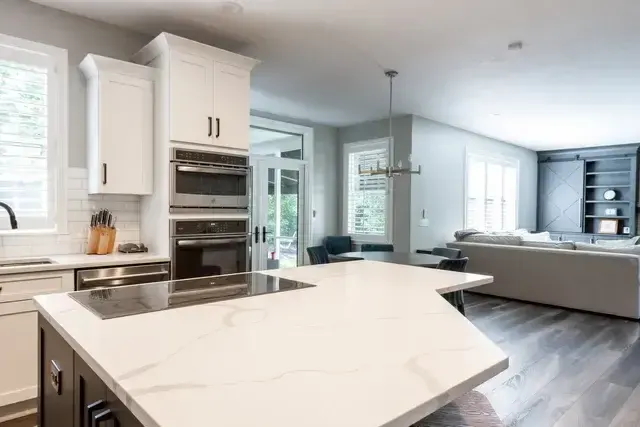
Custom shades measured and installed in WestfieldPlantation shutters fitted to a Westfield windowCellular shades in a Westfield living room
Scope of Work

What Valances & Top Treatments Includes

Every Westfield job is documented item by item. Here is what the crew covers.

Whatever is already at the window documented first, since a top treatment nearly always goes over an existing shade or rod

Headrail depth, bracket projection and any hanging chain measured so the treatment clears what sits behind it

Mounting height set above the opening wherever the window needs to read taller than it is

Finished width run past the trim on both sides so the treatment frames the window instead of sitting on it

Depth proportioned against the full window height rather than taken from a catalog default

Return depth dimensioned to clear the hardware behind it plus a working gap for hands

Style chosen room by room: box pleat, gathered, swag with cascades, shaped hem or an upholstered cornice

Cornice profile drawn full size and checked against the wall before any frame gets cut

Fabric run direction and pattern placement decided so the motif centers on the window rather than wherever it lands

Pattern repeat matched across a bay or a run of windows so every treatment starts at the same point in the design

Welt, banding or applied trim chosen with a physical sample laid against the face fabric in the room

Buckram or interlining added where the fabric needs to hold a crisp edge instead of collapsing

Lining specified so every window presents the same face to the street

Mounting board width, depth and angle brackets sized to the weight and the return

Fasteners landed in framing or in rated anchors, because a cornice hangs off the wall on a lever arm

Access left open for battery wands, motor heads and lift cords living behind the treatment

Level checked across the whole run, since a top treatment sits at eye height and shows a slope instantly

Swags and folds dressed by hand on site, because nothing ships already arranged

Pricing

What Valances and Top Treatments Cost in Westfield

The closest published national figure is the custom drapery range of roughly $300 to $4,000 per window. Top treatments generally sit at the lower end of that, since there's far less cloth in a valance than in a pair of floor-length panels. Read it as a national category range and not a quote for a room in Westfield. What moves the number is construction more than size. A rod-pocket valance in a mid-priced fabric is a modest line item. An upholstered cornice is a built object: a frame gets cut to a drawn profile, padded, wrapped and trimmed by hand. Add a large pattern repeat across four windows in Hamilton County and the yardage climbs before anyone starts stapling.

By Product

How Valances & Top Treatments Differ by Product

Every product in this trade behaves differently in a room. Here is what that means for this work.

Upholstered cornice: A wood frame cut to a drawn profile, padded and wrapped in fabric, then hung above the window. It reads architectural rather than soft, it hides a headrail completely, and it holds a straight top line that no fabric valance can match.

Box pleat valance: Flat panels separated by crisp inverted pleats at regular intervals. It's tailored without being stiff, it suits a stripe or a solid better than a busy print, and the pleat spacing gets set to the window width instead of a default.

Gathered valance: Fabric shirred onto a board or a rod at two or two and a half times fullness. It's the softest of the board-mounted options and the most forgiving of a lightweight fabric, and it belongs in rooms that already lean traditional.

Swag with cascades: A draped center section with tails falling at each side. It carries real formality and it needs ceiling height to look right. The cut is done on the bias so the folds fall properly, which is why a swag is not a beginner project.

Shaped hem valance: A board-mounted valance whose lower edge is cut to a curve, an arch or a scallop instead of running straight. The shape gets drawn to the actual window width so the low points land where you want them, not wherever the pattern piece says.

Flat tailored valance: A single unpleated panel on a board, often with banding at the hem or the sides. It's the quietest top treatment there is, and it's what we specify in a room that wants the headrail hidden without adding any period flavor.

Rod-pocket valance: The simplest version, gathered onto a decorative rod above the window. It costs least, it comes down for cleaning easily, and it works where the treatment is decorative and nothing structural has to be hidden behind it.

Welt, banding and applied trim: A contrast cord at the edge, a flat band inset from the hem, or a fringe along the bottom. This is where a plain treatment gets its personality, and it's also where a second color from the room gets pulled up to the window.

Buckram and interlining: Stiffener and a soft flannel layer built into the treatment so pleats stand up and edges stay sharp. Skip them and a valance sags in the middle within a season, which is the usual reason a ready-made one looks wrong.

Mounting board and angle brackets: The board the treatment staples to and the metal brackets that carry it. Board depth has to clear the shade hardware behind, and bracket spacing has to suit the weight, especially on a cornice with a deep return.

Common Questions

Valances & Top Treatments FAQ

Questions we hear most often from Westfield homeowners considering valances & top treatments.

Functionally no, aesthetically it depends on the opening. On a cased window with proper trim, a roller cassette or a blind headrail looks fine on its own because the casing gives the window a defined edge. On the square set drywall openings that dominate newer Westfield construction there's no casing at all, so the headrail floats as a bare horizontal bar. Some people like that minimalism. Others find the window looks unfinished, and a valance or cornice supplies the top edge the house never got. There's a middle option worth knowing about, which is a shallow fabric wrapped board that covers the headrail without projecting far enough to read as a separate element.
Usually leave the glass clear and treat the assembly as one unit. Wide flat transoms are a feature of current Westfield elevations and they exist to bring daylight in high, so covering them defeats the purpose. What causes trouble is a shade that stops at the top of the main window and leaves a band of bare glass above it, which reads as unfinished. A cornice mounted above the transom, spanning the whole assembly, resolves that and keeps the transom doing its job. If the transom is going to be treated, treating it separately from the window below almost always looks worse than treating the whole assembly as one composition.
The heavily swagged, deeply gathered version is. The idea isn't. A shallow structured cornice in a plain fabric or a painted composite reads as architecture rather than as decoration, and it suits a modern square set opening better than most people expect. What dates a top treatment is scale and fussiness: deep gathers, contrast cording, tails and swags all belong to a particular period. A clean rectangle sized correctly to the window doesn't read as any period at all. Proportion is what dates them, so a cornice that's too tall for the window looks period whatever fabric goes on it, and one sized properly does not.
By the running foot rather than per window, which matters on a wide opening. A cornice over a twelve foot door wall costs considerably more than one over a three foot window, in a way that doesn't apply to per window products. Fabric quantity, whether the face fabric has a pattern repeat that has to be matched across the width, and whether the construction is soft or built on a board all move the number. It's worth quoting two or three options rather than assuming the first idea is affordable. On a very wide opening it's also worth pricing a painted composite cornice against a fabric one, because the fabric quantity on a twelve foot run is substantial.
Yes, and it's one of the more practical uses. A motorized tube is larger than a manual one and the head assembly is deeper, so on an outside mounted installation there's real hardware to look at. A cornice or valance covers it completely while leaving access for service, provided the projection is specified with that in mind. What has to be checked is that the treatment doesn't obstruct a solar charging panel if one is fitted, or block the signal path if the antenna sits in the head. It also gives you somewhere to conceal a low voltage supply on a hardwired installation, which is otherwise a visible cable on a wall with no trim to follow.
No, and doing it everywhere is how a house looks over decorated. The windows that benefit are the ones people look at: the main wall of a great room, a dining room, a front room seen from the street. Bedrooms, secondary baths and utility windows rarely need one. A useful rule is that if two windows are visible in the same sight line, they should be treated the same way, so decide by wall rather than by window, and leave the rooms that don't need it alone. The other reason to hold back is budget, since money spent on a top treatment in a spare bedroom is money not spent on the great room where it shows.
Buckram is a stiffened interlining used in drapery headers and structured top treatments, and it's what makes a pleat hold its shape and a valance keep a clean top edge rather than sagging. It's invisible in the finished product and it's a large part of why a properly made treatment still looks right in year five while a cheaply made one goes soft. When comparing two quotes for what looks like the same thing, the header construction and whether buckram is used is one of the real differences hiding inside the price. You can feel it as well as see it: a header with buckram has a crispness at the top edge that a header without it never quite achieves.
Yes, and order it all together. If the cornice, the Roman shades and the drapery are the same fabric, they come from one dye lot or they will not match, and a large flat cornice face shows a lot variation far more clearly than a gathered panel does. Where the fabric is a contrast rather than a match, we look at both in the room at the time of day the room gets used, because two fabrics that work under showroom lighting can fight each other in west afternoon light. Ordering a yard or two of spare fabric at the same time costs little and covers a future repair, and it stores flat in a closet without any trouble.
Two things. It hides hardware, so the headrail, the brackets and the top of a roller stop being the first thing you see at the window. And it finishes the composition, giving the window a top edge and a bit of softness that a hard treatment alone doesn't have. In a lot of rooms it's the last ten percent that makes the window look designed instead of merely covered. It also mounts above the opening, which makes the window read taller than it measures.
Deep enough to look deliberate and shallow enough to leave your glass alone. A treatment that's too shallow reads like a headband sitting on top of the window, and one that's too deep eats daylight for the rest of its life. We work it against the full height of the window rather than a fixed number, then mock the depth up with a piece of card taped to the wall so you can look at it from the sofa before anything is cut.
A cornice is a built object with a wood frame, so it holds a dead-straight top line and a crisp profile forever. A fabric valance is softer, lighter and easier to change your mind about. Cornices suit rooms with clean architecture and rooms where a headrail has to disappear completely. Fabric suits rooms that want movement. Cost usually runs higher on the cornice because somebody is cutting a frame to a drawn profile before the upholstery even starts.
Usually, and the measurement that decides it is the return depth. The treatment has to project far enough off the wall to clear the headrail, the brackets and any chain or wand hanging behind it, with room left for a hand. We measure that at the window before ordering. Where it goes wrong is a treatment ordered off a size chart without anyone checking what's behind it, and then it fouls the shade every time you raise it.
Yes, and it's one of the more satisfying small projects in this trade. Most people who call about a top treatment already have shades that work fine and a room that still looks unfinished. We measure what's there, work out the return, and build to it. The only real constraint is wall above the opening: if the shade is mounted tight to the ceiling there may be nowhere for a board to go, in which case a rod-pocket treatment on a slim rod is sometimes the way through.
Higher than the opening, in almost every case. Mounting a treatment at the top of the trim makes the window look shorter and squashes the whole wall. Taking the board up toward the ceiling stretches the window visually and gets the treatment out of the daylight. How far depends on your ceiling and on what else is on the wall. In a room with a run of windows, all of them go on one line, even if the openings themselves aren't at one height.
No, and that's exactly why people come to us for this. A top treatment on its own is the answer when you want the softness of fabric without panels stacking on the wall, without floor-length cloth in a kitchen, and without the cost of a full drapery job. Plenty of rooms end there and look finished. If you want the height and the frame that panels bring, a treatment over stationary panels is a good middle option that costs less than working drapery.
It can, and that's a real risk with the wrong style rather than with the category. A heavy swag with fringe in a room with clean lines will look like it arrived from another decade. A flat tailored valance with a contrast band, or an upholstered cornice with a straight profile, reads current and will keep reading current. The style is the decision, not whether to have a top treatment at all. We bring photographs of both directions rather than talking about it in the abstract.
Vacuum the face with a brush attachment a few times a year, and pay attention to the top surface of a cornice, which collects dust nobody sees from below. Steam wrinkles rather than pressing them. For real cleaning, a cleaner who handles fabric window treatments should take it down and rehang it. Don't wash a lined or interlined treatment at home. The layers shrink at different rates and a valance that comes back wavy along the hem can't be rescued.
Yes, and the pattern is the part to get right. Each section gets its own board and its own treatment, and the corners need working out so the returns meet cleanly rather than colliding. The bigger job is matching the repeat, so the design starts at the same point on every section and reads as one treatment wrapping the bay. We template the angles on site, because a bay in an older Westfield house is rarely the angle on anybody's drawing.
A wood mounting board fastened to the wall on angle brackets, with the treatment stapled or hooked to the board. It sounds simple and the failure mode is always the same: a cornice hangs off the wall on a lever arm, so a deep return multiplies the pull on whatever the brackets are screwed into. We find framing where it exists and use anchors rated for the load where it doesn't. Bracket spacing gets set by the weight, not by habit.
It helps and it isn't a substitute for the right hardware. A treatment mounted above the opening with a solid return does close off the path where daylight comes over the top of a roller, and in a den or a living room that's often enough. In a bedroom that has to be genuinely dark, the honest answer is a light-blocking pocket or a closed cassette doing that job properly, with the top treatment sitting over it for looks.
Only if nobody plans for it. Motorized shades have a motor head at one end and, on battery versions, a wand or a battery tube that has to come out roughly once a year. A cornice built tight to the wall over that assembly turns an annual five-minute job into a project. We leave access, either by sizing the return generously or by building the treatment to lift off its board, and we tell you which end the motor lives on.
Kitchens, where floor-length fabric is impractical but the window still looks bare. Powder rooms, where there's no room for anything else and a small treatment does a lot. Dining rooms, where formality is welcome. And any room where a shade is already doing the work and the window still reads unfinished. The rooms where we'd push back are ones with low ceilings and short windows, since anything at the top costs you daylight you can't spare.
Areas We Serve

Valances & Top Treatments Across Westfield

We measure and install in every one of these Westfield neighborhoods. Each has its own page with the build eras, window conditions and mounting notes for that section.

Free In-Home Measure

Schedule Your Free In-Home Measure in Westfield

Contact Information

Reach Us Directly

Our team prioritizes scheduled measures and service calls, and books in-home measures during business hours.

Office
1417 Commerce Avenue, Indianapolis, IN 46201
Hours
Mon-Fri 8a-6p
Service Area
Westfield, IN and Surrounding Areas

Ready to Book Your Measure?

Call us to set up an in-home measure, or to ask about a treatment that has stopped working. We will talk it through on the phone first.

Service area

Serving Westfield and the surrounding area

Call NowGet Quote