Do You Need Blackout, or Will Room Darkening Get the Job Done
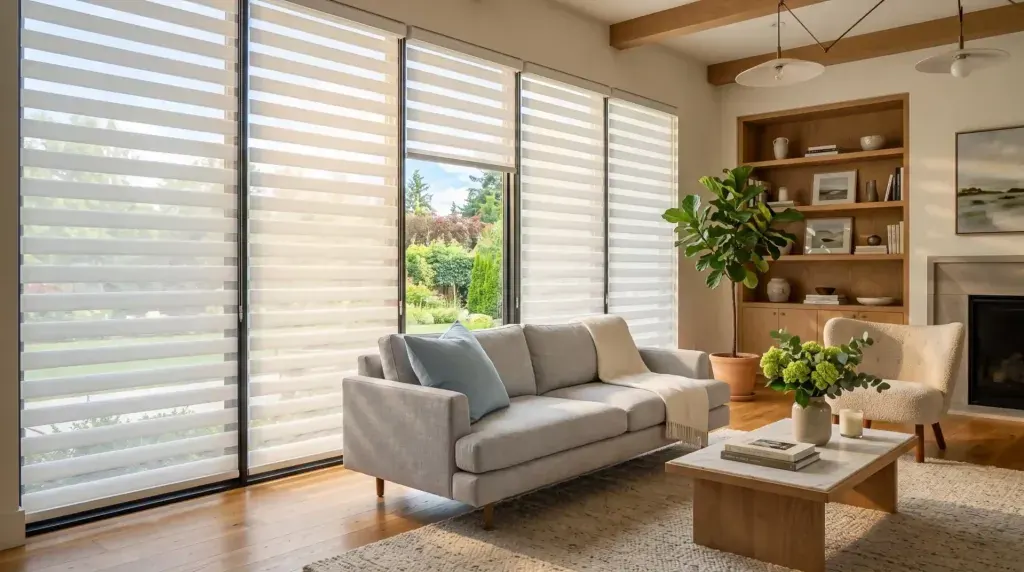
Every fabric shade on the market falls somewhere on a spectrum from barely dimming a room to blocking nearly all of the light, and blackout and room darkening are two specific, different points on that spectrum.
What Blackout and Room Darkening Actually Mean
From a construction standpoint, blackout and room darkening aren't two ends of the same fabric, they're built differently from the start. Blackout fabric is engineered specifically to stop light from passing through the material, full stop. Room darkening fabric is built to reduce light substantially, usually blocking somewhere in the 95 to 99 percent range, without going all the way to fully opaque.
That's a manufacturing decision made before the fabric ever reaches a workroom, not something that varies much by brand. Once you know which spec you're buying, you know roughly what to expect from the material itself.
What you don't automatically know is how dark your specific room in Westfield will actually get, since the mount and the window itself play just as big a role as the fabric does.
Which Rooms Call for Which Option
Where you spend the extra money for blackout matters more than whether you spend it at all in a Westfield home. A primary bedroom, especially a west-facing one or a shift worker's room, is usually worth the upgrade. A guest room that gets used a handful of nights a year is a much easier place to stick with room darkening and save the difference.
Kids' rooms are a personal call rather than a clear budget answer, since some parents want the total darkness for nap time and some prefer the softer glow of room darkening on purpose. Either way, it's worth deciding room by room instead of applying one fabric grade to the whole house by default.
Media rooms and home theaters are the other space where blackout is usually worth the price, simply because the room doesn't function the way it's meant to without it.
How the Fabric and Construction Differ
Blackout fabric for a bedroom is built with layered construction, typically a face fabric bonded to a foam or acrylic middle layer and then a backing, sometimes with a fourth layer for rooms where total opacity really matters. That's what makes it fully block light even when held up to a bright bulb.
Room darkening fabric is lighter, usually built with a single napped or foam-backed liner rather than a full lamination stack. It rolls more compactly and folds more softly, which is a real consideration if the shade is inside mount in a room with limited depth.
One side benefit worth mentioning for a bedroom specifically: the heavier blackout construction also dampens some outside noise, a nice bonus on a bedroom facing a street or a neighbor's yard, even though noise reduction isn't the primary reason most people choose it.
Price Difference Between Blackout and Room Darkening
As a general national range and not a quote for a specific window, room darkening cellular or roller shades commonly run $100 to $300 per window depending on size and fabric grade. Blackout versions of the same style typically run somewhere between $130 and $380, roughly 15 to 25 percent more, because of the extra lamination layer in the material.
That price gap holds across most shade styles, roller and cellular included, since the added cost comes from the fabric construction rather than the shade mechanism itself.
For most Westfield homes, the smarter approach is choosing blackout only where it's actually needed, a primary bedroom or a media room, and room darkening everywhere else, rather than defaulting to the pricier option throughout the house. A free in-home measure will price out both options room by room so the decision isn't made on guesswork.
Figuring out which rooms actually need blackout and which do fine with room darkening is easier with an honest look at how each room gets used. A free in-home measure with Westfield Window Treatments is a good chance to walk through that room by room.
How Much Light Gets Through, Realistically
The mistake we hear about most often after installation in Westfield is a homeowner noticing light around the edges of a brand-new blackout shade and assuming something's wrong with the product. Usually nothing is wrong. Inside-mounted shades need a small gap, typically a quarter inch to half inch per side, to operate without rubbing against the window frame, and that gap lets light through no matter how opaque the fabric is.
This isn't a defect. It's a byproduct of how inside mount shades have to be built to actually function, and it applies to fabric-based products across brands and price points.
The fix, when it matters, is mounting outside the frame with extra width overlapping the trim, or choosing a shade with side channels built to block that gap specifically. Either approach closes the light path that fabric grade alone can't touch.
Frequently Asked Questions
Why is there still light around the edges of my blackout shade?
That's normal for an inside-mounted shade. The fabric blocks light passing directly through it, but the shade still needs clearance along the sides to raise and lower without rubbing the frame, and light gets in through that gap regardless of the fabric grade.
Is room darkening good enough for a nursery?
Plenty of parents choose it on purpose, since it leaves enough ambient glow to check on a sleeping baby without turning on a light. Others prefer full blackout for nap time. It really comes down to what works for your household.
Does blackout fabric block heat and noise too?
It blocks a bit more of both than room darkening does, as a side effect of the heavier, multi-layer construction, though that isn't the main reason most people choose it.
 Blind Repair in Westfield: What Actually Breaks and Why
 Do Your Westfield Windows Need Inside Mount or Outside Mount Blinds?
 Battery or Hardwired: Powering Smart Shades in Westfield