Specialty Shape Windows Cost More. Here's Why, and What You Get
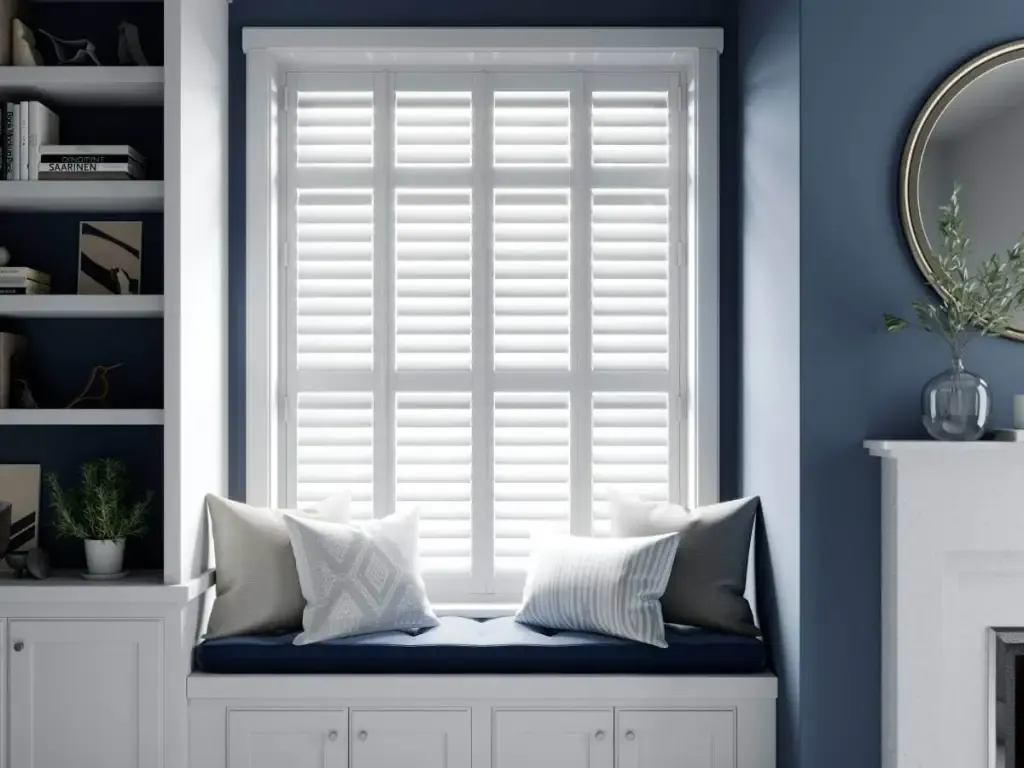
An arch top window can sit bare for a decade while every other window in the house gets treated, mostly because homeowners assume nothing can be made to fit a curve. That assumption is wrong more often than it's right, but it does take a different process than ordering a standard blind.
The Specialty Shapes We're Talking About
From the street, a specialty shape window is usually the first thing anyone notices about a house's front elevation, which is exactly why it's worth getting right rather than leaving it bare. Arch tops over a picture window, half-round transoms above the front door, the occasional octagon or trapezoid worked into a gable: these shapes exist because someone wanted the house to have a little more character than a row of plain rectangles.
The trouble is that character comes with a design gap. None of these shapes take a standard shutter off a size chart, and a bare arch or an uncovered gable window tends to undercut the exact curb appeal it was built to create. A Westfield house with nice shutters on every rectangular window and a bare arch in the middle looks unfinished, even if nobody can quite say why at first glance.
Closing that gap is less about function and more about making the whole front of the house read as one finished design, which is worth thinking about even before getting into fixed versus operable or pricing.
Fixed Panels vs Operable Louvers on the Shaped Section
For a gable window specifically, this decision usually resolves itself fast once people see the height involved. These windows are often 15 to 20 feet up, sometimes higher, and an operable panel up there needs to be paired with a pole or motorized control just to be usable, which adds real cost on top of the already higher price for a working shaped mechanism.
A fixed panel skips that problem entirely. It gets built and set to whatever light and privacy level makes sense, generally a partial or a full block depending on how much afternoon sun that gable catches, and it stays that way without anyone needing to reach it.
For a lower half-round transom over a front door, closer to eye level and easier to reach, operable starts to make more sense, since someone might actually want to adjust it occasionally. Height and reach end up driving this decision as much as budget does, which is worth thinking through before assuming one option is automatically right.
Cost, Lead Time, and What to Expect With a Specialty Order
Standard shutters run roughly 175 to 800 dollars per window nationally. Specialty shapes generally land above that range, and the size of the increase depends on the shape's complexity, how high or hard to access it is, and whether you're going fixed or operable on the shaped section.
The way to keep the number reasonable without cutting corners on quality is mostly in that fixed versus operable decision. Choosing fixed for the shaped section and putting the operable budget into the rectangle underneath, if there is one, gets most of the visual payoff without paying for tilt function nobody will use.
Lead time runs longer than a standard order regardless of which option you pick, simply because of the template and the specialized build. Planning for that extra time, rather than being surprised by it, is the easiest way to keep a specialty shape project from feeling like it went over budget when really it just took the time it was always going to take.
If that arch or angled window has been sitting bare, the fix is more available than most homeowners assume. A free in-home measure is where the actual shape gets traced and the real options get laid out, so you know what you're working with before you decide anything.
Why a Tape Measure Isn't Enough for a Curve
A rectangular window can be measured accurately with a tape and a level. A curved or angled window can't, because a tape only gives straight-line distances, and a curve isn't a straight line. You can capture the width and height that way, but not the arc itself, and a wrong arc means the panel won't seat against the Westfield frame.
What the trade actually does is template the opening. That usually means tracing the exact curve or angle onto stiff paper or thin cardboard held against the window, so the shop cuts to the real shape rather than a calculated approximation. Almost no arch in an actual house is a mathematically perfect curve. Houses shift a little over the years, so the curve you traced is rarely the curve a formula would have predicted.
This is also why DIY on a specialty shape is a much bigger risk than it is on a standard window. Getting a rectangle wrong by an eighth of an inch is usually forgivable. Getting a curve wrong means the panel doesn't sit flush against the frame at all, and there's no returning a custom-cut shaped shutter once it's built.
Why Shutters Handle These Shapes Better Than Soft Treatments
A fabric shade needs a straight track or a rod to hang from and gather along. A curved or angled opening simply doesn't offer one, which is why you rarely see a roller shade or a cellular shade attempted on an arch top.
A shutter starts from a different premise. It's a rigid frame first, built to whatever shape the opening actually is, with the louvers or panel filling that frame afterward. That rigidity is exactly what lets a shop trace a curve or an angle and build hardware that actually holds its shape over the frame long-term.
There's a durability angle too, especially relevant on a window that catches direct sun most of the day, which arch tops above a front door often do. A composite or wood shutter frame keeps its shape regardless of heat or humidity. A shaped fabric panel, if that route gets chosen instead, tends to lose its crisp edge over time in a way a rigid frame simply doesn't.
Frequently Asked Questions
Can you put blinds or shades on an arched window?
Not in the usual sense. Fabric and slat treatments need a straight headrail to hang from, and a curve doesn't give them one. Most arch tops get either a fixed shaped shutter panel or get left bare while the rectangle underneath, if there is one, gets a normal shade.
Do specialty shape shutters open and close like normal ones?
Some do. A true half circle can be built with operable louvers on a curved track, though it costs more and takes longer. Plenty of homeowners choose a fixed panel instead, since the shaped section is usually more about light and privacy than needing to adjust it daily.
How long does a specialty shape order take?
Longer than a standard rectangular shutter, since the shape has to be templated and reviewed before it's built to that exact curve rather than pulled from stock sizes. Expect it to run past the timeline of a standard order.
 Blind Repair in Westfield: What Actually Breaks and Why
 Do You Need Blackout, or Will Room Darkening Get the Job Done
 Do Your Westfield Windows Need Inside Mount or Outside Mount Blinds?